Showing posts with label Audi. Show all posts

Audi A1 e-tron Concept, 2010


Audi A1 e-tron Concept, 2010

The Audi A1 e-tron Concept is a Mega City Vehicle (MCV) with an innovative drive technology. It comes equipped with a powerful electric motor for zero-emission driving in the city. There is also an internal combustion engine on board that recharges the battery in exceptional circumstances. The Audi A1 e-tron Concept is very agile thanks to the 75 kW (102 hp) peak power of its electric motor.

The technology of the Audi A1 e-tron
The e-tron model family from Audi is just a few months old, but it already has a number of members, for each of which Audi has chosen a different drive technology. The first e-tron, which debuted at the 2009 IAA in Frankfurt/Main, is a near-series high-performance sports car with electric motors for all four wheels. The study shown at the Detroit Motor Show in 2010 is a lightweight, compact two-seater with two electric motors on the rear axle.

The Audi A1 e-tron Concept now presents another approach - a compact electric car in the premium class. The four-passenger, two-door MCV city car was designed specifically for use in the metropolitan areas of Europe and North America and in the rapidly growing megacities of Asia and South America. The Audi A1 e-tron always drives on electric power; its internal combustion engine is only used to recharge the battery in isolated cases.

The integration of the new technologies shows the holistic approach that Audi is pursuing with electric mobility. The objective is to use the energy with the lowest possible losses. The precise interaction of the components, their intelligent packaging, and the efficient management of the current flows are the product of the expertise that the company has developed in this area.

Audi has developed a proprietary thermal management system to keep the battery, the electric motor, and the power electronics within their respective ideal temperature windows.
Behind the three e-tron models is a broadly diverse and modular technology platform that continues to grow very rapidly as Audi drives development forward.

The electric motor: 75 kW (102 hp) peak power

The synchronous electric motor of the Audi A1 e-tron is mounted transversely at the front of the car. Its low mounting position has a positive effect on the vehicle's center of gravity. Continuous output is rated at 45 kW (61 hp), with peak power of 75 kW (102 hp) available in short bursts. 150 Nm (110.63 lb-ft) of torque is continuously available, and peak torque is 240 Nm (177.01 lb-ft).

The electric motor sends its power to the front wheels via a single-speed transmission. The elegant, retractable selector lever on the console of the center tunnel used to choose between "Drive," "Reverse," and "Neutral" was taken from the first Audi e-tron.

The power electronics are mounted in the engine compartment above the electric motor. The most important components are the pulse-controlled inverter, which serves as the controller between the electric motor and the battery; the DC converter, which connects the high-voltage network with the 14 volt electrical system; a breaker unit to protect the high-voltage components; and the charging module. The socket for the standard charging plug is located behind the rings in the single-frame grille of the Audi A1 e-tron. A fully depleted battery can be recharged in approximately three hours from the 380 volt grid. A display immediately adjacent to the plug-in connection shows the current charge status and the charging time remaining.

The concept of the innovative Mega City Vehicle requires the electrification of key auxiliaries. The refrigerant compressor of the climate control system, for example, is electrically powered by a high-voltage electric motor that supplies only the amount of power needed at the time.

The increases system efficiency substantially compared to conventional concepts. Thanks to a special circuit, the climate control loop also functions as a heat pump that regulates the temperature of the cabin and the battery.

The power steering of the Audi A1 e-tron is electro-mechanical and thus particularly energy-efficient. An electronic brake system makes it possible to tap into the recuperation potential of the electric motors. A hydraulic fixed-caliper brake is mounted on the front axle, with two novel electrically-actuated floating-caliper brakes mounted on the rear axle. These floating calipers are actuated not by any mechanical or hydraulic transfer elements, but rather by wire ("brake by wire"). In addition, this eliminates frictional losses due to residual slip when the brakes are not being applied. In addition, the servo unit received a new, demand-controlled electric vacuum pump.

The large electric motor powering the Audi A1 e-tron Concept can convert braking energy into electric current and feed it back into the electrical system. The high degree of recuperation benefits overall efficiency. The electric control actions are imperceptible to the driver, who notices only the familiar, precise, and perfectly controllable pedal feel.

The battery pack: a compact T arranged below the floor

The energy storage unit is arranged below the floor, where it is ideal for the center of gravity and weight distribution. The battery pack is shaped like a T, with the short "transverse beam" filling the rear section of the center tunnel and the "cross-beam" filling that area in front of the rear axle where the fuel tank is otherwise located. The 380 volt lithium-ion rechargeable battery has a nominal energy content of 12 kilowatt hours. It comprises 96 prismatic cells and weighs less than 150 kilograms (330.69 lb).

The Audi A1 e-tron can drive 50 kilometers (31.07 miles) emission-free in city traffic on the powerful battery. On longer trips, the battery is recharged by a particularly compact internal combustion engine mounted below the luggage compartment.

The range extender

The Audi A1 e-tron Concept car has a Wankel engine as a range extender, but other compact concepts are also possible. The small single-rotor Wankel has a chamber volume of 254 cc and runs at a constant 5,000 rpm in its peak efficiency window. The electronics also consider navigation data such as the destination and route profile to automatically activate the range extender as needed. The driver can also turn the range extender on and off as necessary with the push of a button The fuel tank holds 12 liters (3.17 US gallons).

The great strengths of the Wankel engine are the nearly vibration-free and quiet operation, the small dimensions, and the extremely low weight. Together with the generator, which is powered by the Wankel engine and produces 15 kW of electric power, the complete assembly weighs only around 70 kilograms (154.32 lb). This weight also includes the special power electronics, the intake, exhaust, and cooling unit, plus the insulation and the sub frame.

Driving experience

The first defining impression that the driver of the Audi A1 e-tron gets is that of nearly total silence. Even the Wankel engine in the back can barely be heard when it is running.

The second characteristic perception is the power of the electric motor, nearly all of which is available instantly and thrusts the Audi A1 e-tron forward with authority. The innovative Mega City Vehicle, which despite its complex drive technology weighs only 1,190 kilograms (2,623.50 lb) delivers zero-emission driving fun in a modern and sophisticated manner. The vehicle accelerates from 0 to 100 km/h (62.14 mph) in 10.2 seconds and has a top speed of more than 130 km/h (80.78 mph).

The Audi A1 e-tron can also cover longer distances if the range extender charges the battery. The extra range, which is intended primarily for interurban driving, is 200 kilometers (124.27 miles).
According to the draft standard, the two different operating modes yield a fuel consumption of only 1.9 l/100 km (123.80 US mpg), which corresponds to CO2 emissions of 45 g/km (72.42 g/mile). In electric mode, there are zero local CO2 emissions - the compact Audi A1 e-tron Concept is thus ecological and economical.

The third impression that the Audi A1 e-tron Concept makes is that of a larger car. The compact two-door boasts all of the strengths of the new A1 model series - the carefully tuned, sporty chassis with specially designed 18 inch alloy wheels and 215/35 R18 tires; the generous, "grown-up" interior; the excellent fit and finish; and a multitude of high-end equipment.
The dark shade "ebony" dominates the interior. The seats - with stone gray seams - and the headliner are in "Alabaster White".

The Design
The concept car in Geneva has a special "Aqua Mint, pearl effect" paint finish; the contrasting roof arch is offset in "High Gloss Steel dark." As with the other two e-tron models, the 18-inch wheels with a 20-spoke turbine design convey the high-tech aspiration of the concept.

The rear diffuser with aluminum trim lacks tailpipes. This emphasizes the width of the vehicle and suggests the low emissions. The two front fenders are emblazoned with the "e-tron" logo.

Audi A4 allroad quattro, 2010


 Audi A4 allroad quattro, 2010

The Audi A4 allroad quattro features all the innovative technologies which impart to the A4 model line its superiority: a range of powerful and highly energy-efficient engines, Audi drive select (intelligent handling technology), the high-tech S tronic transmission, and innovative communication and assistance systems. The vehicle will be available in early summer at a basic price of 37,100 euros.

The design of the Audi A4 allroad quattro recalls the Audi A4 Avant: crisp lines enclose tastefully curved surfaces and the low roof line establishes a coupé-like silhouette. Striking details re-interpret this model line's sporty elegance. The moon-gray single-frame radiator grille bears vertical chrome strips; an accentuated bumper and large air inlets underscore this vehicle's unique identity. Chrome rings encircle the fog lights. And in the option featuring xenon plus headlights, light-emitting diodes comprise the daytime running lights and taillights. Underneath the front end and tail end, the A4 allroad has a stainless-steel underbody guard.

The Interior
Refined touches, uncompromising quality and flawless functionality: the interior of the Audi A4 allroad quattro embodies all the strengths for which Audi is renowned. The cockpit clearly serves the driver. Among the control unit's highlights: the standard electromechanical handbrake - which has replaced the lever on the center console with a button - and the central on-board monitor. A color display complements the concert or symphony sound system, or the MMI navigation system plus; the MMI's offset control unit is housed in the center console.

The Engines
Audi will initially offer three different engines for the Audi A4 allroad quattro: a gasoline engine and two diesel engines. All three are turbocharged direct-fuel-injection engines. They command respect due to excellent performance, impressive pulling power, smooth running, and high fuel efficiency. The engines are further bolstered by pioneering technologies arising from Audi's modular efficiency expertise. For example, all three units boast a standard on-board recuperation system, which converts mechanical energy into electrical energy during deceleration.

The Driveline
The 2.0 TDI transmits its power to a six-speed manual transmission. The 3.0 TDI and 2.0 TFSI feature the next generation of Audi's dynamic and very efficient S tronic. This innovative dual-clutch transmission switches extremely smoothly among its seven gears within a few hundredths of a second. S tronic also excels thanks to its high efficiency ratio and a broad spread of the gear ratios. The seven-speed S tronic has a fully automatic mode at the ready: the driver can shift as required, if necessary via shift paddles on the steering wheel.

The differential is in front of the clutch and immediately behind the engine. This technical stroke of genius made it possible to reposition the front axle much closer to the vehicle's front end, in turn allowing for a long wheelbase and an ideal distribution of the axle loads. The benefits include steady straight-line stability, superb ride comfort, and excellent driving dynamics.

The Audi A4 allroad quattro features quattro permanent all-wheel drive as standard equipment. Its purely mechanical center differential favors the rear, distributing power at a 40:60 ratio to the front and rear axle. If necessary, the quattro permanent all-wheel drive can route up to 65 percent to the front or as much as 85 percent toward the tail end.

The Chassis

The width of the Audi A4 allroad quattro lays the foundation for its driving dynamics. The car's track is 1,583 mm (62.32 in.) at the front and 1,574 mm (61.97 in.) at the rear - some 20 mm (0.79 in.) wider, respectively, than the A4 Avant. The body is higher on account of a new chassis with longer springs, which - like the new shock absorbers - combine sportiness with comfort. The standard, 17-inch lightweight alloy wheels are fitted with 225/55 tires. At a diameter of 690 millimeters (27.17 inches), even this standard configuration looks rather imposing. For the time being, Audi is also offering 18-inch wheels.

The chassis in the Audi A4 allroad quattro retains all the advantages which distinguish the A4 model line. Steering is straightforward and responsive. A steering box beneath the wheel conveys the driver's input directly to the wheels. The five-link front suspension and the self-tracking trapezoidal-link rear suspension consist largely of aluminum to reduce unsprung weight. 16-inch brakes with excellent cooling behavior provide for rapid deceleration. It should come as no surprise that the Audi A4 allroad quattro offers sportiness, comfort, and stability - onroad and offroad. After all, it is an A4.

Audi drive select further enhances the joys of driving. This control system automatically and perfectly adapts the personality of the Audi A4 allroad quattro to the driver's preferences. Audi drive select namely evaluates the engine's throttle response, the Servotronic power steering, and S tronic's shift points in automatic mode. The driver can freely switch among three different engine maps: comfortable, standard, and sporty. And MMI navigation plus provides yet another on-board control option, and is individually programmable.

The Audi drive select can be paired with Audi dynamic steering. It consists of a superimposed gear system, and varies the steering ratio as well as steering assistance in a continuously variable manner. Audi drive select functions directly at low speeds and indirectly at high speeds. At the vehicle's cornering limit, the dynamic steering keeps the Audi A4 allroad quattro on course via split-second corrective actions - subsequently obviating extensive ESP intervention.

Audi A1, 2011


Audi A1, 2011


The interior of the Audi A1 is also sporty and of high quality. Customers can customize numerous details to tailor the car to their personal tastes. Audi's latest model has a broad portfolio of advanced technologies on board; its infotainment system sets new standards in the segment. The Audi A1 is the first premium automobile in the small compacts class - a true, fully-fledged Audi.

The Audi brand stands for automotive passion. With its agile chassis and powerful engines, the Audi A1 is the sportiest car in its class, and this is readily apparent at first glance. The design is unique and modern. Styling cues placing the Audi A1 in the Audi family include the side line with the distinctive roof arch, the coupe-like C-pillars, the large wheel wells and, of course, the front end with the typical single-frame grille. The hood and rear hatch encompass the body; the tail lights are three-dimensionally molded and present an unmistakable design, day or night.

The interior: airy and dynamic

The interior of the Audi A1 is spacious and airy. The instrument panel is suggestive of an airplane wing; its four round air nozzles are reminiscent of the turbines of a jet. The clear ergonomics and the uncompromisingly high fit and finish typify the Audi brand's high standards. Many lovingly designed details in the interior document the premium character of the Audi A1.

Concentrated driving pleasure: the sportiest car in its class

The sporty, agile chassis of the Audi A1 places it at the head of its class. Whether in the city, on an interurban road or on the highway - the Audi A1 is great fun to drive anywhere thanks to its sporty setup, the optimized weight distribution and the very direct steering. The standard ESP stabilization system with electronic axle-differential lock makes the handling of the Audi A1 even more sporty and precise, while driving safety is increased even further.

The new Audi A1 also sets new efficiency standards. Audi is sending the new model line into the fray with four four-cylinder engines, with the two TDI and two TFSI gasoline engines producing between 63 kW (86 hp) and 90 kW (122 hp). All of the engines follow the downsizing principle - they substitute turbocharging for displacement and draw their fuel through direct injection units.

All versions of the Audi A1 impress with good fuel economy, with standard cycle values between 3.8 and 5.4 liters per 100 kilometers (43.56 - 61.90 US mpg) (provisional values). The 1.6 TDI with 66 kW (90 hp) and manual transmission emits only 99 g of CO2 per kilometer (159.33 g/mile). All of the engines are equipped with a recuperation system that allows them to recover energy during braking, and are coupled with an automatic start-stop system. A new temperature management system with switched water pump contributes to the low fuel consumption of the 1.2 TFSI.

High-tech and efficiency: the seven-speed S tronic

At Audi, efficiency is always high-tech. The Audi A1 is available with the seven-speed S tronic transmission. The dual-clutch transmission changes gears extremely quickly, comfortably and without detectable interruptions in pulling power. It offers both automatic and manual modes, with paddles on the steering wheel available as an option. It provides for tremendously fun driving and also further reduces fuel consumption - typical Audi.

The Audi A1 is sporty, powerful and attractive. As a newcomer in the compact segment, it appeals to a modern customer group - a young, urban, lifestyle-oriented public. Audi A1 customers - many of whom are expected to be women - are interested in design, music, fashion and sports. The entry-level model will be priced at around 16,000 euros.

Design

It has a confident road stance - powerful, distinctive and full of character: The Audi A1 is both the premium option and the athlete in its class. The pronounced encompassing shoulder line, the color-contrasted roof arch and the unusually sharply sloping C-pillars give the three-door an unmistakable silhouette. The dimensions also document the dynamic lines: 3.95 meters (12.96 feet) long, the latest model from Audi is an impressive 1.74 meters (5.71 feet) wide but only 1.42 meters (4.66 feet) tall. The wheelbase measures 2.47 meters (8.10 feet); the overhangs are correspondingly short.

The design of the Audi A1 is tightly integrated into the brand's design language and unique in the compact segment - emotional, bold and progressive. Audi has a reputation for taking a lot of ideas and innovations from its concept cars into series production, and the Audi A1 continues this tradition. Many of the features and innovative ideas from the 2007 Audi A1 project quattro showcar have already made it to series production in the Audi A1.

The front end bears an unmistakable family resemblance, but features unique accents and innovations in the details. The single-frame grille, for example, is harmoniously integrated into the front end and with its angled top corners represents a new evolutionary stage. Its braces are arranged horizontally to emphasize the width of the front. The large, plastically modeled air intakes with their horizontal bars also contribute to the sporty appearance of the Audi A1. The fog lights are located in their outer corners.

The three-dimensionally styled headlights also have their own special look. The Audi A1 looks determined and concentrated to the road. A strongly curved wing structures the interior of the headlights. As with every Audi, the daytime running lights are standard. With the optional xenon plus units, the daytime running lights are implemented using LEDs and a light guide. They appear as a homogenous strip that traces the wing.

Powerful design element: the tornado line
The most striking impression when viewed from the side is the straight, slightly upward course of the lines, which visually stretch and accelerate the Audi A1. The upper edge of the hood extends below the side windows to the rear end. As with the Audi TT sports car, the point where the encompassing hood meets the fenders is the point of origin for a typical Audi design element - the tornado line. It continues in the door and the rear flank. The line runs closely and precisely above the wheel wells, giving the Audi A1 a powerful road stance.

The heavy shaded edge beneath the tornado line, the powerfully arched sheet metal surfaces on the flanks and the rising dynamic line above the sills are also characteristic of the brand's design language. The same is true of the expressively shaped wheel wells, which provide shelter to wheels measuring up to 18 inches, and for the ratio of sheet metal surfaces to the greenhouse, which is two-thirds to one-third. The side mirrors are mounted on the doors like with a sports car; the door handles are distinctly bow-shaped.

Body
An Audi truism also applies to the Audi A1: The body establishes the foundation for the quality, for the precise, sporty handling and for safety. Two-thirds of the body comprises high- and ultra high-strength steels of different strength classes.

The strongest of these are the hot-shaped steels. The blanks are heated in a furnace to extreme temperatures then immediately shaped in a water-cooled pressing die. This rapid change in temperature imparts them with extreme tensile strength. Hot-shaped steels make up a good 11 percent of the body. They are used for the lower crossmember in the footwell, in the rear sections of the longitudinal members, in the B-pillars and in the roof frame - anywhere extreme strength combined with low weight is particularly important.

The high- and ultra high-strength steels are a significant factor for the high torsional rigidity of the body and its low weight of only 221 kilograms (487.22 lb). These two values and the dimensions are used to compute the high lightweight quality of the superstructure while also providing the basis for a high level of occupant protection.

The Audi A1 comes standard with two front airbags, side airbags in the backrests of the front seats and two curtain head airbags. Belt tensioners and belt force limiters plus the Audi integral headrest system round out the package of retention systems. Isofix child seat anchor points in the rear are standard. Belt buckle sensors at all seats are another increased safety feature. And when it comes to pedestrian protection, the Audi A1 is also equipped with cutting edge technology.

Low-speed collisions - light bumps in parking lots and the so-called typical claim crash so important for the insurance rating - do not result in any major damage. The layout of the bumpers, the crossmember behind them and the longitudinal members protect cost-intensive components such as the radiator and air conditioners.

Aerodynamically optimized: from the front skirt to the rear spoiler

With 0.32 coefficient of drag for the base model, the newest Audi is among the most aerodynamic cars in its class. This is the result of extensive fine-tuning at the Ingolstadt Wind Tunnel Center. The entire body has been optimized - from the rear spoiler, including the spoiler edges, to the underbody and the wheels. The aerodynamic underbody largely covers the underbody, protecting it and creating favorable aerodynamic air flow.

The corners and other edge regions of the skirts feature a sophisticated design that not only sinks the coefficient of drag, but also improves driving stability at high speeds. The area around the grille is completely sealed so that the inflowing air reaches the radiator with virtually no losses instead of becoming turbulent. Even such subtleties as the flow of air through the engine compartment have been optimized to the finest detail with respect to thermo- and aerodynamics.

Another of the body's strengths is its acoustics. The Audi development engineers devoted considerable attention to the sound radiation of the large sheet metal panels and their rigidities. All regions at which forces are induced during driving were specially reinforced. A lightweight insulation package brings the acoustics in the passenger cabin up to the premium level.

The Audi A1 will be built at the Audi plant in Brussels. Audi invested more than 100 million euros in the modernization of the production facility in order to completely satisfy the most stringent of quality standards.

Interior

Sportiness, precision and youthful freshness - these themes characterize the interior of the Audi A1. The designers looked to airplane wings for inspiration for the elegantly curving instrument panel. The four round, far-protruding air nozzles are reminiscent of the turbines of a jet.

The center console, with its integrated strip of secondary switches, resembles the stern of a yacht and appears to float above the center tunnel. The control unit for the climate control system and the three cylindrical rotary dials of the optional automatic climate control system are another optical and haptic highlight on board the Audi A1. The instrument panel is also home to the head unit for the radio or the optional MMI control and infotainment system. The display, which is standard with the concert radio or higher, is retracted into the instrument panel and extends upward at the push of a button. This installation position, ideal for quick reading, is a unique selling point in this vehicle class.

Helpful: the on-board computer with efficiency program
The on-board computer with efficiency program is linked to the driver information system. It displays data relevant to fuel consumption and gives recommendations for efficient driving. An enlarged view of the gear-change indicator signals to the driver when he or she should change gears. Another function provides information on which on-board consumers, such as the climate control system or the rear window defogger, are active and how much fuel they are consuming.

The seats in the Audi A1 offer great hold, guidance and support and seat persons of all sizes extremely comfortably. A height-adjustable driver's seat is standard. The Ambition trim line includes sport seats with lumbar support, and the passenger seat also comes height-adjustable as standard. The easy-entry function for comfortable access to the back is also standard with the Ambition package.

Plenty of storage is available at every seat - two cup holders on the console of the center tunnel, pockets in the doors and the rear side trim as well as a power outlet. On the base model, there is a fold-up compartment on the instrument panel instead of the on-board monitor. Audi also offers an optional storage package with additional stowage options.

The premium character of the Audi A1 is expressed in every last detail of the interior - in the selection of the materials, in their fit and finish and in the tight, even gaps. The surface of the instrument panel is softly backed with foam; all buttons and controls move precisely; even the pull handle that unlatches the hood release does so crisply and precisely.

Standard with the Ambition trim line and optional with Attraction are numerous aluminum-look control elements, including the entry strips, the dials for the automatic climate control system and the light dials. Furthermore, the ring of the three-spoke sport steering wheel, the parking brake handle and the gear shift lever are wrapped in leather and adorned with subtle aluminum clips.

Youthful and new: colors and materials
The materials in the interior vary between the two lines. Attraction features black or titanium gray cloth upholstery with the center console, armrest, map pocket and speaker grills also being titanium gray. The sport seats in the Ambition line have a two-color design featuring titanium gray or wasabi green as a contrasting color to black. The interior is also available in black. The media style package offers velvet beige as an alternative. The optional leather seats available with the Ambition line and the media style package are offered in a choice of three colors and three combinations.

Everything about colors and trim is novel, youthful and lifestyle-oriented. The air nozzle housings are available in a wide range of colors - with matt or high-gloss black standard depending on the trim line. They are also optionally available in high-gloss white, titanium gray, wasabi green, red or velvet beige to match the color of the trim. Audi also offers a range of attractive colors for the door armrests and the console on the center tunnel for all trim lines.

Infotainment systems
The Audi A1 is a premium automobile for modern people - it offers a range of state-of-the-art infotainment and multimedia systems directly from the luxury class.
The infotainment system comprises modular components based around the standard chorus radio, which has an mp3-capable CD drive and GALA speed-dependent volume control. The chorus radio delivers its sound to four loudspeakers.

The next step up features the new concert radio, a versatile device that is likewise equipped with a CD drive. The separate, retractable on-board monitor - a high-resolution, 6.5 inch color display - is standard with this radio. It also features a dual tuner, an SDHC memory card reader, an AUX-in connection and six loudspeakers front and rear.

The concert radio also unlocks the choice of the optional connectivity package, which includes a navigation system preparation. This allows the customer to add an Audi map-based navigation unit to the radio at a later time. The required hardware is already installed in the radio. The customer can purchase the system activation and an SDHC card with the navigation data through Audi Genuine Accessories at any time. Activation is performed by the Audi dealer. The connectivity package also includes a Bluetooth interface, an SDHC card reader and the Audi music interface.

The top of the line is MMI navigation plus, a high-end media center that is a benchmark in the compact vehicle class. It comprises four primary components - the main unit with a 60 gigabyte hard drive, the radio unit, the MMI control terminal and the color display. The retractable 6.5 inch display features elegant images. It displays its graphics as well as the cover art for the audio titles. The navigation map is also displayed in 3D.

Classic Audi logic: the MMI control terminal

With its intuitive logic, the MMI control terminal is structured similarly to the units from the large Audi models. A large rotary pushbutton is at the center of the unit. It can be rocked in four directions like a joystick, which makes many functions even more convenient. A variety of hard and soft keys, a volume control, and slots for the storage media are arranged around and above the central controller.

Drivetrain
Audi will initially offer the Audi A1 with four engines. The two TFSI gasoline engines and the two TDI diesels cover a power range from 63 kW (86 hp) to 90 kW (122 hp). Each of them is state-of-the-art.

All of the engines employ direct fuel injection and turbocharging. This downsizing concept coupled with technologies from the Audi modular efficiency platform give them tremendous power with minimal fuel consumption ranging from 3.8 to 5.4 liters per 100 km (43.56 - 61.90 US mpg).

The entry-level gasoline engine is the new 1.2 TFSI. It generates 63 kW (86 hp) and produces its peak torque of 160 Nm (118.01 lb-ft) already between 1,500 and 3,500 rpm. Coupled with a five-speed manual transmission, the four-cylinder accelerates the Audi A1 from 0 to 100 km/h (0 - 62.14 mph) in 12.1 seconds on its way to a top speed of 179 km/h (111.23 mph). In the EU driving cycle, it consumes only 5.1 liters of fuel per 100 km (46.12 US mpg), which corresponds to only 119 grams of CO2/km (191.51 g/mile).

Downsizing from Audi
: turbocharging instead of displacement
The newly developed four-cylinder exemplifies the Audi philosophy of downsizing, the substitution of turbocharging for volume. The engine with two-valves per cylinder displaces only 1,197 cc and has been rigorously optimized for low weight and low friction. Its cast aluminum crankcase has its own cooling loop separate from the cylinder head. The water in the block is not circulated immediately after the engine is started, enabling the engine to come up to temperature more quickly and shortening the phase of increase frictional resistance due to cold oil.

The 1.4 TFSI ups the ante with 90 kW (122 hp). Its peak torque of 200 Nm (147.51 lb-ft) is continuously available between 1,500 and 4,000 rpm. A turbocharger with a water-cooled intercooler pressurizes the 1,390 cc engine with four valves per cylinder.

Together with the seven-speed S tronic, the 1.4 TFSI gets the Audi A1 up to highway speed in 9.1 seconds. Top speed is 200 km/h (124.27 mph). The standard six-speed manual transmission bumps the time for the sprint to 9.2 seconds, but does not affect top speed. Average fuel consumption is just 5.1 and 5.4 liters/100 km (43.56 and 46.12 US mpg), respectively, in the EU test cycle.

The power output of the new 1.6 TDI comes from a displacement of 1,598 cc. Internal friction in the compact four-cylinder has been systematically minimized. Audi offers two versions of this engine. The more powerful 1.6 TDI unit produces 77 kW (105 hp) and 250 Nm (184.39 lb-ft) between 1,500 and 2,500 rpm, and is coupled with a five-speed manual transmission. The 16-valve engine accelerates the Audi A1 powerfully through the standard sprint in 10.8 seconds before reaching a top speed of 187 km/h (116.20 mph) while consuming an average of just 3.9 liters/100 km (60.31 US mpg).

The second version of the 1.6 TDI generates 66 kW (90 hp) and 230 Nm (169.64 lb-ft) of torque between 1,500 and 2,500 rpm. Coupled with the five-speed manual transmission, it accelerates the Audi A1 from 0 to 100 km/h (0 - 62.14 mph) in 12.2 seconds. Its reaches a top speed of 179 km/h (111.23 mph) and offers exemplary fuel economy of 3.8 liters/100 km (61.90 US mpg), which corresponds to 99 grams of CO2/km (159.33 g/mile).

All four engines in the Audi A1 use a technology from the Audi modular efficiency platform - the recuperation system uses an intelligent voltage controller for the generator to recover energy during the braking and coasting phases and store it temporarily in the battery. The next time the car accelerates, this energy flows back into the on-board electrical system, relieving the load on the generator.

The 4 engines also come standard with a second technology from the Audi modular efficiency platform - the start-stop system. This turns the engine off when the car is at rest, if the gear selector lever is in neutral and the driver's foot has left the clutch pedal. Start-stop then turns the engine back on as soon as the clutch pedal is depressed — all the while functioning quietly, conveniently, and quickly.

Chassis
The front-wheel-drive Audi A1 is the sportiest car in the compact class. It is nimble and agile in the city; steady and precise on interurban roads, and comfortable on the highway. It owes these qualities primarily to the highly advanced chassis with the wide track and balanced weight distribution.

The engineers devoted a great deal of attention to the distribution of axle loads during the development of the Audi A1. Measuring only 81 centimeters (31.89 inches), the front overhang is unusually short. Depending on the engine, only between 61 and 63 percent of the weight rests on the front axle, a low value for a compact car. A number of details contribute to this, such as the position of the battery, which with most engine options is underneath the luggage compartment. With a base weight of only 1,045 kilograms (2,303.83 lb), the Audi A1 is the lightest vehicle in the premium compact class.

The front suspension comprises a MacPherson construction with lower triangular wishbones. The steering impulse from the electrohydraulic rack-and-pinion power steering, which is more efficient than a straight hydraulic system, is transferred via short paths to the pivot bearing for spontaneous steering response and precise, sensitive feedback through the steering wheel.

Direct: the power steering
At a ratio of 14.8:1, the steering is sportily direct, requiring only slight steering angles at the wheel. The high turn-in of the front wheels keeps the turning circle to 10.6 meters (34.78 feet) - both factors give the Audi A1 the ultimate in agility in city traffic as well as on open roads.

The Audi A1 comes equipped with a new Audi technology regardless of the engine selected - the ESP stabilization system also includes an electronic differential lock. Similar to a mechanical locking differential, it makes the already agile handling even more neutral by largely eliminating understeer and improving traction. If the electronics detect that the load on the front inside wheel is reduced too much, it initiates brief, controlled braking of that wheel. The excess torque then flows to the outside wheel, which can apply more power to the road. Road behavior is even more precise, agile, stable and neutral, further enhancing objective safety and subjective confidence in the car.

High performance: the wheel brakes
The sporty performance, top-class safety and comfort required in the premium compact class place high demands on the brakes. The brake system of the Audi A1 was selected specifically for the performance of the different variants.
Even the models with the entry level engines should therefore have plenty of braking power in reserve. Every vehicle comes equipped with ventilated disc brakes up front and massive brake discs in the rear.

Sport steering wheel
In keeping with the vehicle's sporty character, the Audi A1 comes standard with a grippy three-spoke sport steering wheel that can be optionally wrapped in fine Nappa leather and trimmed with high-quality chrome-design elements.

Equipment and trim
The Audi A1 in two trim levels. Attraction is the richly appointed charismatic version; Ambition the sporty and dynamic variant. Both lines can be combined with the media style package, which offers attractive infotainment and interior design options. Features such as the navigation package can also be purchased later, keeping the Audi A1 fresh and attractive for years to come. The latest member of the Audi family also follows a fresh, young line with respect to materials and colors in the interior.

The Attraction line comes equipped with a number of comfortable features - the chorus radio, a radio remote-controlled central locking system, power-adjustable side mirrors, power windows and a height-adjustable driver's seat. Standard passive safety features include two front airbags, side airbags and head airbags. Belt force limiters, the integral Audi headrest system and Isofix anchor points for child safety seats in the rear round out the program.

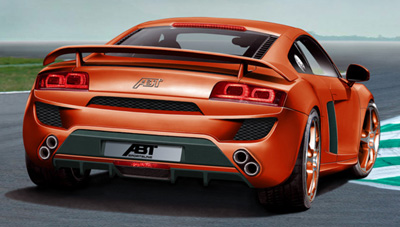
ABT Audi R8, 2008

ABT Audi R8, 2008


The Abt R8: Sports car in perfection

There are cars and dream cars. The latter includes Lamborghini's Gallardo, Ferrari's F430 or Porsche's 911 Turbo. These cars make your heart beat faster and show the perfected magic of speed on the roads. Abt Sportsline's R8 will also be among these outstanding super sports cars and is getting ready to overtake them in the prestige duel.

The design studies already show the first impressions of Abt's sportiest creation - and prove that the Kempten-based tuner manages to perfect an excellent serial model like the R8 to detail and accentuate its racing genes already in the drawing. The front of the Bavarian R8 shows the marked Abt face. Together with the unique and beautiful rear with its four inclined arranged exhaust end pipes, the rear diffuser and the extravagant rear wing, the front of the Abt R8 is part of an overall concept that brings about phenomenal roadholding. The add-on parts of the super sports cars from the Allgäu-region improve downforce and ensure perfect balance of the front and rear axis. This is especially notable in speed ranges reserved for only a few cars. The sideblades which were developed especially for the Abt R8 and the Abt side skirts give the Abt R8 a new and individual design besides aerodynamical advantages. The aerodynamically efficient Abt body kit, which also includes carbon-fibre parts, is a real eye catcher but also shows the state-of-the-art Bavarian precision work. With the ingenious construction, which also includes a carbon-fibre bonnet, not only a maximum reduction in weight is achieved but it also ensures optimized weight distribution of the Abt R8 - the pure presence of the model athlete already shows this.

The technology and the design milestones do not only come from Maranello or Sant'Agata-Bolognese but also from Kempten. The Abt R8 will be a gorgeous dream car with the genes of a top-class race car. This special automobile will belong to one of the fastest among the fastest; the Abt R8 will also challenge the Lamborghinis and Porsches. With regards to the anticipated performance data the Bavarians are traditionally discreet. But this data already amazes sports car fans and makes them want to spur the hot-blooded Bavarian horses. 530 HP (390 kW) are to be drawn from the 4.2 litre-V8 thanks to the Abt supercharger. Compared with the serial model which already shows impressive performance data this means an increase of 110 HP (81 kW). The brand new Abt 20-inch BR wheels stylishly transfer this power onto the asphalt. The all-wheel-drive dream car accelerates from 0 to 100 km/h in just 3.9 seconds and reaches a top speed of 317 km/h. These values are synonymous with magic and this extraordinary super sports car desperately wants to be driven. By means of the Abt suspension which is adjustable in height, pressure and rebound, the performance and driving comfort of the super sports car can be adapted perfectly to the requirements of its driver.

ABT Audi TT-R, 2007

ABT Audi TT-R, 2007


The Abt TT-R
The real racer from the exclusive Kempten-based tuning company bears the letter "R" in its name - of course the powerful version of the TT performing incredible 355 HP (262 kW) does, too. In a flash, namely 5.1 seconds, the sportscar reaches the 100 km/h threshold.

The cockpit of the TT-R has a lot to offer its ambitious driver.
With its dynamical design it harmonizes perfectly with the sporty vehicle character - steering wheel, gear shift knob and centre console are kept in exclusive carbon-leather optics.
The magical three letters that convert a beautiful Coupé into a race car can also be found in the car interior again, as everybody driving a TT-R cannot get enough of this exclusive model.

Audi Q7, 2006

Audi Q7, 2006


The Q7 is the large Audi for sporty individualists, for people who are seeking a vehicle that will take them anywhere they want to go for sports, recreation, and business. Its dynamic proportions and distinctive lines express this character, and subtle modifications endow its styling with even more elegance.

The design: The language of dynamics
At the front end, the large single-frame radiator grille has been redesigned. Vertical chrome bars contrast with its black high-gloss finish. The bumpers too have been restyled. Their lower section is now painted in a contrasting black or gray, depending on the body color. The newly integrated underbody protection in the center section of the bumper has a distinctive ribbed design.

The interior: Room to spare
Thanks to its luxurious 300-centimeter (118.11-inch) wheelbase within an overall length of 5.09 meters (16.70 feet), the Audi Q7 has interior room to spare, and the interior flexibility is unrivalled. The seatbacks in the second row are divided into three fold-down sections to provide a level cargo floor.

This increases the luggage space from a volume of 775 liters (27.37 cubic feet) to 2,035 liters (71.87 cubic feet). With the leather upholstery option, the middle seat now has an even more comfortable contour.

Two very useful features are optionally available: either a longitudinally displaceable second seat row or individual comfort seats that are separately displaceable. Another available option is a third row for passengers no taller than 1.60 meters (5.25 feet), combined with an improved easy entry function.

A multitude of detailed improvements in the interior enhance the elegance and the sense of well-being. The instrument cluster has been redesigned: the large, round, easily readable instruments are encircled by metallic frames. Interior lights in the door linings and an inlay on the passenger side enhance the interior styling. Many details of the control elements have been restyled and also enhanced by chrome elements.

The selection of interior colors and materials is also new. Upholstery fabrics are available in black and light gray; leather upholstery additionally also in Para Brown, Savannah Beige and Cardamon Beige. Standard inlays are finished in matt black. In optional design packages, aluminum and wood finishes are used.

The power train: Performance and efficiency
The Audi Q7 is available with six powerful and highly efficient direct injection engines, two of them gasoline-powered and four diesel engines, including the world's most powerful diesel SUV, the Audi Q7 V12 TDI. Their power is transmitted via a convenient and fast-shifting six-speed tiptronic to the quattro permanent all-wheel drive, which distributes it between the axles with slightly more than half to the rear.

The 3.0 TDI puts out 176 kW (240 bhp) and delivers as much as 550 Nm between 2,000 and 2,250 rpm, yet on the EU cycle it consumes only 9.1 liters / 100 km (25.85 US mpg). The optionally available 3.0 TDI clean diesel even consumes 0.2 liters (0.05 US gallons) less.

Despite highly complex exhaust gas recirculation and the resulting world's cleanest diesel technology, it consumes just 8.9 liters/100 km (26.43 US mpg). It meets the strict LEV II Bin 5 US standard and already complies with the Euro 6 limits announced for 2014.

The technology of the TDI clean diesel is highly complex. An advanced version of the common rail injection system with 2,000 bars of pressure, new combustion chamber sensors and a high-performance exhaust recirculating system ensure a highly efficient combustion process. An innovative DeNOx catalytic converter reduces the remaining nitrogen oxides. Just upstream of it, a pump injects an additive named AdBlue into the hot exhaust flow, where this solution decomposes into ammonia, which splits the nitrogen oxides into harmless nitrogen and water. Audi partners replenish the additive during regular maintenance servicing.

Abt Audi TT-Limited Wide Body, 2002

Abt Audi TT-Limited Wide Body 2002

Abt TT-limited wide body. From the race track to the road.
Two well-known Abt highlights played a role in the concept of the TT-limited wide-body: the TT-Sport and the TT-limited. In the past few month, both of them have attracted many customers and even more fans. With the limited wide body, the Abt team is now showing a spectacular synthesis of its two most extreme tuning versions of the TT. Thus, the successful company from Kempten demonstrates the state-of-the-art in TT-tuning.

The TT-limited wide-body has got lost from the race track directly on the open road. Responsible for this is the spectacular bodywork kit. As a result of extensive wind tunnel tests, the specialists from Kempten have established an aerodynamic kit, which results into more downforce and therefore a better road-holding. No matter if on local roads or on the motorway. And, of course, on the race track. For instance at the Nurburgring, where Laurent Aiello has scored two brilliant victories for the Team Abt Sports line with the Hasseroder-yellow Abt-Audi TT-R.

Aerodynamics, suspension and the impressive sport braking system - all of this serves for controlling the fireworks, that the Abt-technicians are lighting underneath the bonnet. 228 kW (310 hp) are the result of a power boost, that turns the standard 165 kW (225 hp) strong engine into a racing machine. An Abt turbocharger with inter cooler and exhaust system allow the standard power plant to breathe freely. A top speed of approx. 254 kph and an acceleration from 0-100 kph in approx. 5.6 seconds speak for themselves.

Audi R8 Spyder 5.2 FSI quattro, 2011

Audi R8 Spyder 5.2 FSI quattro, 2011


Audi R8 Spyder 5.2 FSI quattro - exceptional performance and breathtaking dynamism coupled with the intense sensations of open-top driving. Its lightweight cloth top opens and closes fully automatically; several body parts are made of a carbon fiber composite material.

The top, which comprises an outer skin of a leakproof textile fabric and the headliner, is fully compatible with high-speed driving. When driving at moderate speeds with the top up, interior noise levels in the Audi R8 Spyder are barely higher than in the Coupé.

Close attention to detail: the design
Numerous details demonstrate that the Audi designers put their hearts into the design of the Audi R8 Spyder 5.2 FSI quattro. The air inlets in the nose, which direct air across the three radiators, and the lip of the front skirt are painted high-gloss black. The struts in the broad, low, single-frame grille are finely coated with chrome. The standard full-LED headlights are technical works of art.


Sporty luxury: the interior
The open-top two-seater from Audi features a generously spacious interior. The three-spoke leather multifunction sport steering wheel is flattened at the bottom as in a race car, and the low-mounted, electrically adjustable seats guide and support the body perfectly.

Quality of fit and finish is extraordinary and the controls are clear and logical. The standard driver information system includes a lap timer for recording lap times. The instruments and the gear lever knob feature red rings. The pedals, the footrests and the shift paddles of the optional R tronic are in aluminum look. Highlighting the list of standard equipment are a generous full-leather package featuring Fine Nappa leather, an excellent sound system from Bang & Olufsen, a deluxe automatic air conditioning system and heated seats. Six different interior colors are available.

Door sill strips coated with aluminum and adorned with black satin finish applications impart an air of luxurious sportiness. Three storage compartments are integrated into the rear bulkhead, one of which contains the optional CD changer or Audi music interface, if desired. There is a front compartment for 100 liters (3.53 cu ft) of luggage.

The latest version of the navigation system plus with MMI operating logic is also standard in the Audi R8 Spyder 5.2 FSI quattro. It features higher resolution and particularly fast route calculation. The system's most visible new feature is the high-resolution, 6.5-inch display.

Uncompromising power: the engine
The Audi R8 Spyder 5.2 FSI quattro, which was developed in cooperation with quattro GmbH, dazzles with uncompromising performance. The V10 engine with the aluminum crankcase, much of which is hand-built, follows in the grand motorsports tradition at Audi.

The 5.2-liter engine features FSI direct fuel injection. The high 12.5:1 compression ratio that this enables contributes to the high performance and good fuel efficiency. Equipped with a manual transmission, the Audi R8 Spyder 5.2 FSI quattro consumes an average of 14.9 liters of fuel per 100 km (15.79 US mpg) - a good figure given its power. With R tronic, this figure improves to 13.9 liters (16.92 US mpg). Dry sump lubrication, another motorsports technology, ensures that the supply of oil is maintained even at the maximum lateral acceleration of 1.2 g.

Dazzling performance: the chassis
The Audi R8 Spyder 5.2 FSI quattro has a 2.65-meter (8.69-ft) wheelbase and a 43:57 axle load distribution. Like in a race car, there are double triangular wishbones made of aluminum at all four wheels. The hydraulic rack-and-pinion power steering conveys highly precise road contact.

The chassis is tuned for good comfort, thanks in part to standard Audi magnetic ride technology. This uses magnetic fields in the shock absorbers to adjust their response to road conditions within milliseconds and adapt to the driver's style. The driver can choose between two base characteristics. A sports suspension with conventional shock absorbers is available as an option.

The Audi R8 Spyder 5.2 FSI quattro is built by quattro GmbH at the Neckarsulm plant. The vehicle, including the ASF, is largely hand-built. The open-top two-seater will be launched in Germany in the first quarter of 2010. Its base price 156,400 euros.


Audi RSQ Concept, 2004

Audi RSQ Concept, 2004


The Audi RSQ is a mid-engined concept car developed for use as a product placement in the 2004 sci-fi movie I Robot. It is meant to depict a technologically advanced automobile from the year 2035.
This sports coupé is a visionary interpretation of Audi's typical automobile design. An important challenge presented to the designers was that despite its extreme character the car still had to be recognized by the audience as an Audi. To accommodate this demand, the engineers implemented a current Audi front-end design that includes a single-frame grille and the company's trademark overlapping rings.


The RSQ also includes special features suggested by movie director Alex Proyas. It utilizes spheres instead of wheels and its two butterfly doors are hinged to the C-posts of the body.

Though this kind of collaboration was a first for Audi, a similar project was developed by Lexus for use in the 2002 film Minority Report