Showing posts with label Volkswagen. Show all posts

Volkswagen Passat CC R-Line, 2010

Volkswagen Passat CC R-Line, 2010

R-Line equipment is already offered on seven Volkswagen models. Now the Volkswagen Passat CC R-Line has got a sportier touch. Orders are now being taken for the four-door coupé with R-Line package.

On its exterior, 17-inch (optional 18-inch) R-Line "Mallory" alloy wheels with 235/45 tyres lend a sporty touch to the Volkswagen Passat CC R-Line. The front spoiler and side skirts, each painted in body colour, were also re-styled. In addition, R-Line logos embellish the front side sections; the rear lights are smoked.

The inside of the Volkswagen Passat CC R-Line, standard features include details like four customised tread plates in aluminium (with R-Line Logo in front) and a three-spoke leather-trimmed steering wheel with multifunction keys. The R-Line package has front fog lights and the Park Pilot system. The Passat R-Line leaves few wishes unfulfilled; even the base version of the Volkswagen Passat CC includes comfort and convenience features like sport seats and a climate control system.

The R-Line package is available with all Volkswagen Passat CC engines. Prices start at 2,200 Euros for the Passat CC 2.0 TDI (140 PS / 103 kW) with a 6-speed gearbox. Counting versions already introduced on the Golf, Scirocco, Touran, Tiguan, Passat, Passat Variant and Touareg, a total of eight models with R-Line equipment are now on the market.

Volkswagen Golf Variant, 2010


Volkswagen Golf Variant, 2010

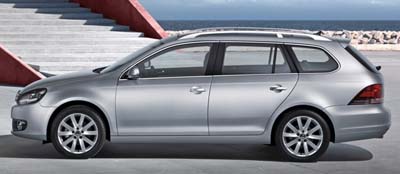
The Volkswagen begins accepting advance orders for the new Volkswagen Golf Variant. In the sixth generation of the world bestseller, after the 2-door and 4-door VW Golf and the latest Volkswagen Golf Plus, this is the fourth body version to be launched. The estate is one of the most successful models on the market, particularly in the company car market. The extensive redesign of this Estate should ensure that the all-around talent further extends its position as a business estate car and as a first car for families as well. The base price of the new Volkswagen Golf Variant in Germany, including ESP, six airbags, daytime running lights, roof railing, power windows all around, upshift indicator, power and heated outside mirrors, 1/3 to 2/3 split folding rear bench seat and seatback, central locking with RF remote control, climate control and 1,495 litres of cargo capacity is € 18,500.

The front end of the Volkswagen Golf Variant was completely redesigned. Its visual appearance follows today's Volkswagen "Design DNA". From now its appearance is defined by clear horizontal lines and bold headlight styling. The car's engine lineup was adopted directly from the Volkswagen Golf 2-door and 4-door models. In the interior, the high-end instruments of the current Volkswagen Golf set the tone. In Europe, first units of the new VW Golf will be delivered in September 2009.

The features and the engines
At its market launch - in parallel to advance sales that are now starting - the successful Estate (more than 95,000 new vehicle registrations in 2008) will be offered in the three equipment versions Trendline, Comfortline and Highline. The latter replaces the previous Sportline version as the top equipment line. Engines available for selection when advance sales begin are a TSI (boosted gasoline direct-injection engine) with 90 kW / 122 PS and two very quiet common rail turbo-diesels (77 kW / 105 PS and 103 kW / 140 PS). Other engines will follow in stages: two Multipoint engines (59 kW / 80 PS and 75 kW / 102 PS) and another TSI gasoline engine (118 kW / 160 PS). All six engines fulfil the new Euro-5 emissions standard.

The exterior details of the new Volkswagen Golf Variant

In front, the new VW Golf Variant can be recognized by its new bumper, radiator grille and engine hood styling and its modified fenders and headlights, which were all adapted 1:1 from the estate's 2-door and 4-door counterparts. In contrast to the previous model, the front-end design is no longer defined by a chrome radiator grille, rather by a black, horizontally layout of the grille and front bumper painted in car colour. In the lower area, the Estate has an additional large air inlet too. Starting with the mid-level equipment version (Comfortline), chrome inserts are integrated in the radiator grille and the lower air inlet. In the top Highline version, this also applies to the frames for the front fog lights with new static turning light function that are a standard feature here.

At the rear, the independent design of the previous model has been upgraded in the new generation by modified, more elegant taillights and bumpers fully painted in car colour in the lower area. From now on, TDI and TSI versions can also be recognized by their tailpipes, which are no longer covered by the bumper. In addition, Volkswagen developed a new wheel lineup for the new Volkswagen Golf Variant.

Interior details of the new VW Golf Variant
The sixth generation VW Golf received excellent marks, especially for its high-end quality. In the interior, it was especially in the styling of the gauges that the Golf crossed boundaries to the next higher class and still does. The same gauges and instruments, including a standard multifunctional display and upshift indicator, are now being used in the new Volkswagen Golf Variant too. Also adopted from the Golf was the new generation of three-spoke steering wheels, which celebrated their debut in the Volkswagen Passat CC in 2008.

In this context, controls for the new Golf climate control system were integrated in the VW Golf Variant as well. Volkswagen also adapted its line of different seat covers (Trendline: "Roxy"; Comfortline: "Scout"; Highline: Alcantara/fabric "Merlin") to the entire model series. The same applies to features ranging from the radio and navigation systems up to the interfaces for MP3 players and Bluetooth mobile telephones. Two driver assistance systems are also available as options for the first time in the Volkswagen Golf Variant: "ParkAssist" (automatic parking assistant) and "Rear Assist" (rearview camera). Another feature being offered is the panorama sunroof that is popular among many Volkswagen Golf Variant buyers.

The Euro-5 engines of the new Volkswagen Golf Variant in detail

Volkswagen is launching the new VW Golf Variant on the market with four gasoline and two diesel engine options; they all meet the limits of the new Euro-5 standard. The entry level continues to be marked by an 80-PS gasoline engine, followed by a 102-PS version. The two most powerful gasoline engines (TSI with 122 PS and 160 PS) and the two turbo-diesels (TDI with 105 PS and 140 PS) may be ordered with an optional automatic DSG dual clutch transmission.

The entirely new to the Volkswagen Golf Variant's engine lineup is the 105 PS common rail TDI. Like the larger 2.0-liter TDI, the 1.6-liter four cylinder is also characterized by noticeably comfortable noise levels, low emissions (119 g/km CO2) and an extremely low average fuel consumption (4.5 litres per hundred kilometres). Compared to the previous model of the same power, fuel consumption was reduced by 0.7 litre.

The 2.0 TDI was adopted from the previous generation of the VW Golf Variant; it also has a highly advanced common rail direct injection system. The 140 PS strong and 210 km/h fast Volkswagen Golf Variant 2.0 TDI consumes 5.0 litre (132 g/km CO2), which is impressively low considering its power. The TDI engines may be ordered together with any of the three equipment versions.
 
The gasoline engines of the Volkswagen Golf Variant have power levels of 80 PS (MPI), 102 PS (MPI), 122 PS (TSI) and 160 PS (TSI). The base engine with 80 PS is available with the Trendline equipment line; the 102-PS version may be ordered as a VW Golf Variant Trendline or VW Golf Variant Comfortline. The TSI engines can each be ordered together with the Comfortline or Highline equipment versions.

How efficiently the current gasoline engines from Volkswagen perform is well-illustrated by the TSI. Its 6.3 litre (122 PS) and 6.4 litre (160 PS) fuel consumption values place their average fuel consumption on par with the already economical base engine with 80 PS. When shifted by a DSG transmission, fuel consumption is even reduced to 6.0 litres per 100 kilometres (139 g/km CO2) on the 122-PS TSI and 6.1 litres (143 g/km CO2) on the 160-PS version. With this engine lineup, the new Volkswagen Golf Variant is one of the most economical and cleanest estate cars in Europe.


Volkswagen Golf GTD, 2010, Car Accident Lawyers


Volkswagen Golf GTD, 2010

After the Polo, the Blue Motion offensive and the Golf GTI, Volkswagen is pulling the next arrow out of its quiver: the Volkswagen Golf GTD. It is extremely fuel efficient yet exceedingly sporty, and it is debuting as a world premiere at the 2009 Auto Mobil International in Leipzig (March 28 to April 05). The GTD code letters carry on a tradition: the first VW Golf GTD appeared back in 1982 - it was the GTI among diesels. Now Volkswagen has perfected the various aspects of sportiness. The new Golf GTD with its 125 kW / 170 PS is aimed at all diesel fans who value a maximum in dynamic performance. This is where the GTD shows a clear affinity to the new GTI (155 kW / 210 PS). While the GTI is in its own league with an efficient turbo gasoline engine that offers the same performance as far more expensive sports cars, the Volkswagen Golf GTD is making its appearance with phenomenal fuel economy. Every 100 kilometers, just 5.3 liters of fuel flow through the piezo injection valves of the common rail engine that can hardly be pegged as a diesel. That is equivalent to CO2 emissions of just 139 g/km. The contrasts with a top speed of 222 km/h and 8.1 seconds for the sprint to 100 km/h.

The Range of about 1,000 kilometer
The GTI, the GTD's 6-speed manual transmission may be swapped out for an optional 6-speed DSG - which in the eyes of many experts is the most efficient automatic of our times. The Volkswagen Golf GTD with DSG reaches a top speed of 220 km/h; it accelerates to 100 km/h in 8.1 seconds and consumes 5.6 liters diesel on average (147 g/km CO2). These low fuel consumption values take both GTD variants to distances of about 1,000 kilometers on one tank of fuel (55 liters).

The VW Golf GTD exterior
The exterior clearly indicates that this is the sportiest VW Golf with a diesel engine. Take the front end, for example: the bumper, radiator grille and headlights are a 1:1 match with the GTI. However, the red horizontal stripes in the radiator grille are styled in chrome on the GTD. At the rear, the turbo-diesel sports a modified diffuser. Even though no GTD emblem comes with the car purchase, the diesel version of the Golf can be recognized by its dual chrome tailpipes on the left side of the diffuser (the GTI has one tailpipe on the left and one on the right).

VW Golf GTD interior

Volkswagen's GT philosophy is also reflected in the interior. It expresses itself in standard high-end sport seats, a 3-spoke leather steering wheel whose curvature flattens at the bottom (GTD signature in the center chrome badge), leather parking brake lever and leather gearshift boot with stitching in contrasting color.

VW Golf GTD safety and convenience
Another standard features of the Volkswagen Golf GTD include details such as a black roofliner and black roof pillar trim, special interior accents, seven airbags including knee airbag on the driver's side, automatic climate control ("Climatronic"), front fog lights with chrome framing, daytime running lights, ESP, a winter package (with heated windshield washer nozzles, heated front seats, headlight cleaning system and low washer fluid indicator light) and the RCD 210 radio system.

_____________________________________________________________________________
 
Auto Accidents
Source : http://accident-law.freeadvice.com

Auto accidents happen every day in America and are a common cause of property damage, physical injuries and death. If you have been involved in a car accident, you may be entitled to receive compensation for your damaged property and for any other harm that the accident caused. Compensation generally includes payment of medical bills and lost wages plus compensation for other damages like pain and suffering. This compensation may come from your own insurer or from the driver who was responsible for the accident, depending on the circumstances of the incident and the law where you live. These factors and the extent of your injuries and damages will also dictate the amount of car accident compensation available. In this section you will find information on auto accident laws, including how and when another driver can be held at fault and how to deal with insurance companies.

_____________________________________________________________________________

Volkswagen Scirocco Studie R Concept, 2008


 Volkswagen Scirocco Studie R Concept, 2008

It was a triumphant drive: in May 2008, three VW Scirocco GT24 cars lined up at the start of the 24-hour endurance race on the Nürburgring track. At the wheel: driving legends the likes of Hans-Joachim Stuck and Carlos Sainz. The teams drove two 238 kW / 325 PS strong race cars to a dual victory at the finish line, first and second in their class. Now Volkswagen is presenting a street version of the race car at the 2008 Bologna Motor Show: the Volkswagen Scirocco Studie R Concept. A genuine Grand Tourismo with a 198 kW / 270 PS engine that delivers aggressive propulsive power. This power is distributed by a 6-speed dual clutch transmission. Adapted directly from car racing are the coilovers, the four-piston brake calipers and a sound-optimized exhaust system with its oval, polished tailpipes.


The concept emulates the race car version. Take the front end, for example: here the design adheres to the motto "Form follows function"; it features three large air inlet openings that guarantee optimal cooling of the brakes and engine. The front splitter that was added minimizes aerodynamic lift of the front axle. Also adopted from the racing version is the engine hood with its auxiliary air vents.

The radiator screen, diffuser and underside of the rear spoiler are treated in high-gloss black, and this provides a strong contrast to the white exterior paint. Supplemented by a "Bologna 08" badge, red and green stylistic elements on a white background create an Italian tricolor. The outside mirrors are also coordinated with this color scheme.

The Interior
Italy's national colors are also represented in the interior. White and black create the basic theme, similar to the exterior color of the Volkswagen Scirocco Studie R. The seams of the Recaro racing shell seats, steering wheel, front armrest, gearshift lever trim and floor mat edging are designed in the colors of the tricolor. Inside, nappa leather in "Deep black" and "Berry white" is applied to the uncompromisingly designed racing shell seat. The shell seats are upholstered with a deep black leather in carbon look. An eye-catching feature here is the conspicuous yet refined contrast of low and high-gloss elements of the carbon structure. Interior accents also consist of genuine carbon composites. The footwell features aluminum pedals specially designed for this vehicle.


Volkswagen Up Concept, 2007


 Volkswagen Up Concept, 2007

There are cars that endure for all times. They are icons of their type, masterpieces of craftsmanship and technology; they put ideas into motion, make progress tangible and sometimes quite simply make everyday life better, more practical and enjoyable. Many of these cars carry the VW logo. "Bug, Beetle, New Beetle", "T1, Bulli, Samba bus, California", "Golf, GTI". Now Volkswagen is presenting - as a world premiere at the International Motor Show (IAA) in Frankfurt - a concept car that once again has the right stuff needed to move more than just one generation. It is a small, pure and high-spirited Volkswagen that pays tribute to its environment. The overall concept is marked by an innovative, clear, intuitive functionality.
Concept
The up! is a city specialist, a car for four persons and all languages, for the job, the university, the drive to the beach and the excursion outside the city gates. A small car that shows a lot of size, because it offers more space than any other car of similar length (3.45 meters) and width (1.63 meters). Its engine - conceivable here are all facets of technology that can be sensibly applied - will run in the rear. And that changes everything: Space, mood and design.Walter de Silva, Chief Designer of the Volkswagen group, sums it up like this: "The up! is not a car whose form will become obsolete within a very brief period of time. It shines in its cleverness and yet is made with loving care. And so the up! is a clear and strong statement for future Volkswagen design." Furthermore, the team of designers and engineers has envisioned the up! concept car as the first member of an entire model line; other facets are entirely conceivable.

Exterior design
The fact that the engine of the up! runs in the rear has a decisive inf luence on its exterior design. That is because the up! has no classic radiator grille. It forges links to the Beetle. This fact alone gives it a great deal of independence. Dominant design characteristics are the headlamps that take an inward and diagonal line, between them the horizontally arranged air vents, the VW logo (as one of the few details kept in chrome), the tailgate that extends far forward and the smooth bumper with a circumferential black stripe as a detail of the "happy face" that is typical of Volkswagen.

In many areas, technology and design have melded into a vehicle architecture that is not only appealing, but is also very utilitarian. The rear end of the up! is a good example of this. The tailgate was produced using a transparent material. Under this gate developers also integrated the high layout of the taillights. Another feature that is technically and visually new is the location of the VW logo in the tailgate; it is also located behind glass and illuminates when the light is on. The rear bumper was designed to match the "happy face" in front.

The powerful appearance of the up!, despite all of its compactness, is emphasized by a very wide track width (1.42 meters) relative to vehicle width. The wheels are flush with the sporty outboard wheel arches and side skirts. The radial design of the wheels and surfaces extending right up to the edge of the rim make the 18-inch wheels appear significantly larger than they actually are.

The wheels that are arranged far outboard in the bumper areas reduce body overhangs to a minimum. All of these features are part of an unmistakable side profile with a very long roof arch as well as clear and large surfaces. Giving shape to its style here are the large doors and the lateral window surfaces, which incline sharply upward at the height of the rear wheel arch and thereby help to form the very independent C-pillar design.

Interior design
Mounting the engine in the rear opened up entirely new interior concepts. Relative to its exterior size, the space offering is exceptionally forward-thinking. The same is true of its variability: Except for the driver's seat, all other seats can be folded and removed. Since they are designed as light shells, they can be quickly stowed in one of the cargo areas - besides the front trunk there is also one in the rear - to free up space. Afterwards, the entire passenger compartment length can be utilized as a storage area for especially bulky objects.

To achieve the high level of seating comfort that is usual at Volkswagen, besides their ergonomic design, in the case of the up! this level of comfort is also attained by a simple yet very effective trick: Similar to a self-inf lating air mattress, air can be sucked out of the seat surfaces via a valve. This means that the seats can be adjusted 1:1 to the body anatomies of the occupants who have just
taken a seat.
Intuitive controls
On its up! concept car, Volkswagen is presenting some completely new solutions when it comes to operator controls. Klaus Bischoff, Chief Designer for the Volkswagen Brand, comments on this: "Another reason the up! is so fascinating is because everything, every detail, was thought out anew. In the interior we have a touchscreen with new proximity sensor technology for controlling the navigation, radio, trip computer and climate control systems. It is operated absolutely intuitively. As a result, the most complicated functions can be controlled like child's play."

In the cockpit, a 8-inch monitor shows the driver key information such as vehicle speed, fuel level and range, as well as momentary CO2 emissions.

In the center of the instruments - equally easy for driver and front passenger to see and control - an 7-inch monitor shows the way that future human-machine interfaces will look and operate. Here all conceivable functions can be controlled via the mentioned touchscreen, which also reacts via proximity sensor to gestures, i.e. specific hand movements.

The developers intentionally separated "display" and "control" levels from one another. Always shown on the screen is a control bar with standard functions such as climate control or audio volume control. Developers packaged functions of other higher-order systems - navigation, telephone, radio, images, movies, etc. - on a display level that has been referred to internally as the "main menu carousel" - a type of virtual carousel. It consists of the icons of different system functions (telephone, navigation, etc.).
When the user touches the "main menu carousel" it can be rotated by touchscreen. Visually, this control is just as spectacular as it is intuitive. When the desired function appears on the main menu carousel - such as the telephone - all the user needs to do is move his or her hand to the display to switch over to the telephone menu, thanks to proximity sensor technology. The new type of user control is fun, easy to understand in any cultural environment and very safe. That is precisely what is typical of Volkswagen.